
Attract international talent. Take on Responsibility.
12. August 2026
Europe's labour market is becoming increasingly international. Demographic change is fundamentally reshaping labour markets and leading to an unprecedented demand...


Carlo Explores the World – Even on LinkedIn!
30. June 2026
Will leaders become obsolete? The future of employee engagement
6. July 2026Carlo Explores the World – Even on LinkedIn!
30. June 2026Will leaders become obsolete? The future of employee engagement
6. July 2026Why do some salespeople close more sales than others? Why do some leaders manage to build exceptional teams, and some don’t? Why are we brilliant in some occasions, and a total failure in other ones?
Why do some salespeople close more sales than others? Why do some leaders manage to build exceptional teams, and some don’t? Why are we brilliant in some occasions, and a total failure in other ones?
Neuroscience provides some eye-opening answers. Neuroscience is the study of how the brain develops and impacts behaviour and cognitive functions. As an Executive Coach I believe that understanding how the brain works can help managers to become more conscious of how they unintentionally bring out the worst in themselves and others, and how they can bring out the best instead.
This is a complex topic, I'm not a neuroscientist, and performance is certainly influenced by several factors. However, in a very simplified way, the following three basic concepts might give you an insight into how you could make a difference to both the quality of your relationships and the results you get in your work – and in your personal life.
In order to describe the three concepts, I will refer to the following areas in our brain: the Prefrontal Cortex, also called ‘Executive Brain’, and the Amygdala, also called ‘Primitive Brain’.
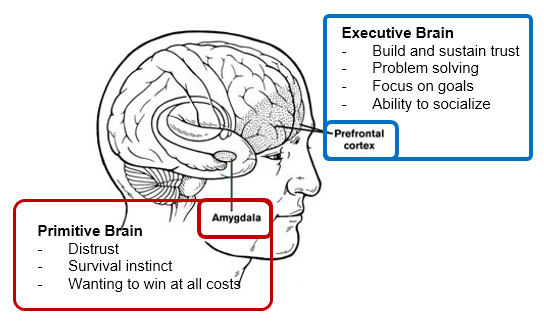
CONCEPT No. 1: When we feel safe, valued and understood, we operate out of the Executive Brain. Our brain floods with oxitocyn and we feel good. Neurological connections are activated and new ones are created. We ignite our creativity and our ability to build relationships, to focus, think strategically and solve problems. How does this translate at work? For example, when a leader manages to build trust by creating a positive emotional climate with his team, and by exposing intentions with transparency (no hidden agenda), team members feel safe and valued. At this point, when the leader offers a vision for shared success, along with a compelling goal to focus on, the team members’ Executive Brain is able to function at its best. As a result, the team works together with renewed energy and passion, finding effective ways to overcome obstacles and achieve success. In this example, both the leader and the team manage to bring out the best in themselves.
CONCEPT No. 2: When we want to be right at all costs, or when we feel threatened / belittled / rejected, we operate out of the Amygdala, our Primitive Brain. The amygdala is thought to be responsible for our emotions and our survival instinct. When it takes over, we experience the so-called ‘Amygdala hijack’: Our brain floods with cortisol, a stress hormone that locks our brain down and puts us in a Fight/Flight/Freeze mode. In this state, it becomes virtually impossible for us to access the 'more elevated' functions in our prefrontal cortex and we act in a dysfunctional way. How does this translate at work? For example, a boss is upset and heavily criticizes an employee. The employee feels shocked and her brain gets stuck. She doesn’t find a smart answer and rumbles, which makes things worse. Based on what the boss sees in that moment, he thinks that the employee is indeed incapable. He doesn't care about all the praise the employee gets from other people. The employee perceives her boss’s negative judgement, feels ashamed and angry. The next time she gets in front of the boss, her anxiety triggers the amygdala again, causing her to perform poorly again. In this example, both the boss and the employee operate out of their amygdala and bring out the worst in themselves.
CONCEPT No. 3: Broken connections can be restored. In the example above, the connection between the boss and the employee was broken, like the connection between the amygdala and the Executive Brain functions. When we realize that we are operating out of our Amygdala, we can regain access to our Executive Brain by changing our brain chemistry, for example through breathing, taking a walk, and looking at the situation from a different perspective. Similarly, when we realize that the person in front of us is operating out of their Primitive Brain, we can help that person to reconnect with their Executive Brain in order to create a more meaningful conversation. The key for this is to restore Trust. How does this translate at work? For example, during a sales negotiation a prospective customer suddenly shuts down, saying that he is not interested in the product and that the price is too high anyway. Something had triggered him to feel threatened and get into a Flight mode. The salesperson realizes it and openly admits that he had been pushing too much, apologizing for it (Transparency). Then he explains that he really cares about helping the customer, and therefore he would like to understand what might be holding the customer back (Relationship and Understanding). Trust starts being rebuilt, the customer feels reassured, and the sales conversation resumes. Judith E. Glaser describes this process in detail in her book 'Conversational Intelligence'.
The answer to the initial questions in this post lies in the ability to move ourselves and others from Distrust to Trust. Distrust causes our brain to assume the worst and shut down for protection; Trust causes our brain to assume the best, open up and operate at its best, helping us to build positive relationships and get better results in what we do. Neuroscience also shows us that we get what we believe. Our thoughts, beliefs and emotions about ourselves and others affect the neurochemistry in our brain, which in turn affects our behaviour. Our behaviour affects another person’s thoughts and emotions, which in turn affect their own neurochemistry and their behaviour. As you see, we are all connected, and we can easily get caught up in a spiral, which can be negative or positive depending on the kind of beliefs we hold.
If you are not satisfied with your co-workers’ performance, ask yourself these questions:
Author: Myriam Callegarin
Ready for modern leadership?
Find out more about the Leadership Activation Journey (LAJ), a concept developed by Myriam Callegarin and contact us for a no-obligation consultation!
Myriam Callegarin is a Global Executive Coach and Leadership Consultant. She works with successful leaders who want to upgrade their ability to bring out the best in themselves and their teams, so they can add extraordinary value to their companies and customers. She combines an extensive corporate and business experience with a deep passion for coaching as a tool for personal, leadership and organizational development. Some references: Daimler, Ford Motor Company, Porsche, Roche, Luxottica, UniCredit, Banca Intesa San Paolo, Chiesi, Ferrero, Bonduelle, ENEL, E.On, World Food Programme (United Nations) and more.


Related posts

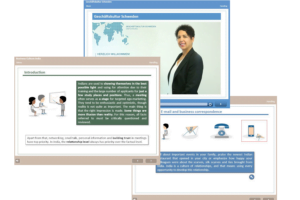
With our more than 30 innovative e-learning courses to date, you’ll become fit for intercultural business situations. You and your employees control your own learning process – just the way you need it: Where, when and for as long as you like! Become familiar with the most important cultural business peculiarities of a country, in order to “survive” intercultural business situations.

In contrast to the traditional waterfall method of change management, the agile route assumes that change is possible everywhere in the system. Along this route, teams and their development are especially important as sites for change. In this regard, learning nuggets represent a significant component to agile and thus autonomous learning. Short videos, brief study units, our Cultural Navigator as prework, e-learning sessions, topic-specific apps, guided lunch & learn units or numerous other flexible and spontaneously employable tools can be used as an alternate or enhancement to various topics. You will find several learning nuggets in our portfolio. In addition, we delight in the chance to develop new ones with you, in order to structure agile and thus sustainable learning in your enterprise.
We’d be happy to take the time to tell you about our learning nuggets or develop some with you.
In our workshops, you can develop your goals, spheres of activity and strategies with our guidance. Our moderators provide a supportive atmosphere and lend a temporal and content-based structure to your topics. That means you can work out your topics quickly and in a practical and target-oriented manner. The expertise of each individual team member is the hub of this activity. We make use of this expertise through methods in which cooperative work is supported. The narrow focus on one specific topic in a precisely defined time period enables concentrated and success-oriented work.
Get in touch with us, and we’ll develop the right workshop for your objectives.
Most of the learning process – studies cite approximately 70% - happens during the normal work day. Self-directed learning thus becomes the most important component of learning in an enterprise. In order to do justice to this circumstance, there is no way around moving from “prepackaged learning” to agile learning formats. This modern approach can be organized very well with several combinable tools and methods. Learning thus becomes sustainable and is no longer reduced to the simple memorization of facts. ti communication has always viewed training as a part of a process and not as a singular event. Now we are even greater advocates than ever of developing the space and opportunities for learners in an enterprise to educate themselves. We are happy to advise HR and PE staff along this path and ready to support teams and managers with concrete learning nuggets, tools, e-learning courses, etc.
We’ll bring your learning processes to life. Just talk to us and see for yourself.
Processes represent the nervous system of an enterprise. Structures keep those processes grounded. In the complex environment of companies, the ability to make decisions and speed at which they are made play a decisive role in success. We will develop processes and structures with you that will increase efficiency and decrease transaction costs. Interfaces become seamless sources of continual improvement. Together, internal processes are clarified, whether they be innovation, administrative, sales or control processes. Tasks, roles and goals are defined and measured. Understanding internal and external customers and supplier relationships bolsters this continual improvement process. Measuring the results gives employees feedback on their own efficiency and that of the team.
To find out if our solutions will work for you, click here to arrange a brief conversation.
Our virtual short seminars give you initial fundamental information. In these virtual sessions, lasting no more than two hours, we can sensitize you to the basics or peculiarities of selected topics or countries. Each of these virtual short seminars ends with a final question round, in which a few questions can be asked and answered about the topic. This format is ideal for pairing basic information with brief opportunities to pose questions.
To find out if our solutions will work for you, click here to arrange a brief conversation.
Our virtual training will open up the world to you. The combination of compact knowledge transfer, a personal relationship to the trainer, practical exercises and the development of concrete transfer strategies are what makes our training sessions unique. Our experienced senior trainers are able to create a stimulating learning atmosphere, even in a virtual space, and to capture the interest of participants through an extremely interactive structure.
Your advantages:
To find out if our solutions will work for you, click here to arrange a brief conversation.
Our training opens up the world to you with compact knowledge transfer and a personal relationship to your trainer. There are topics and developments that are best treated in a face-to-face format. Especially those training units that are strongly focused on exercises and trying things out can be more easily and spontaneously implemented in person. Face-to-face training promotes networking between participants to a greater degree. Particularly in breaks spent with each other, there are opportunities to exchange ideas which are not insignificant. Face-to-face training lives on the interactive structure and the dynamic of being able to address participant questions in a more individual and targeted manner and the ability to create a beneficial learning atmosphere. Classic face-to-face training, however, is not necessarily the measure of all things. From our point of view, it is especially the combination of face-to-face elements with other digital components which boosts the learning process immensely.
Develop the personalities of your best people in a targeted manner with coaching. Our coaching sessions are dedicated to the holistic further development of selected employees with regard to current or expected challenges in teams locally or internationally. Tailored to their respective needs, our experienced coaches work together with clients to identify strengths and deficits and cultivate personal goals and implementation strategies in order to improve basic key qualifications, leadership style, time management, creativity or presentation techniques. In doing so, where needed, we implement proven methods of personnel assessment and leadership development.
To find out if our solutions will work for you, click here to arrange a brief conversation.
We engage our moderators in seminars and conferences, in organizational development, in congresses and conventions, in meetings and in project and quality management. The objective is always to develop a common learning process. Moderation facilitates successful process control, the securing of concrete results and professional conflict resolution. Skilled employees and managers can then more easily work together, even with participants from other cultures, to set goals, develop strategies or design products. Our experienced, interculturally competent and neutral moderators ensure a professional, collaborative and goal-oriented work process, thus taking the burden off of your accountable employees.
To find out if our solutions will work for you, click here to arrange a brief conversation.